The Long Southern Strategy by Angie Maxwell & Todd Shields
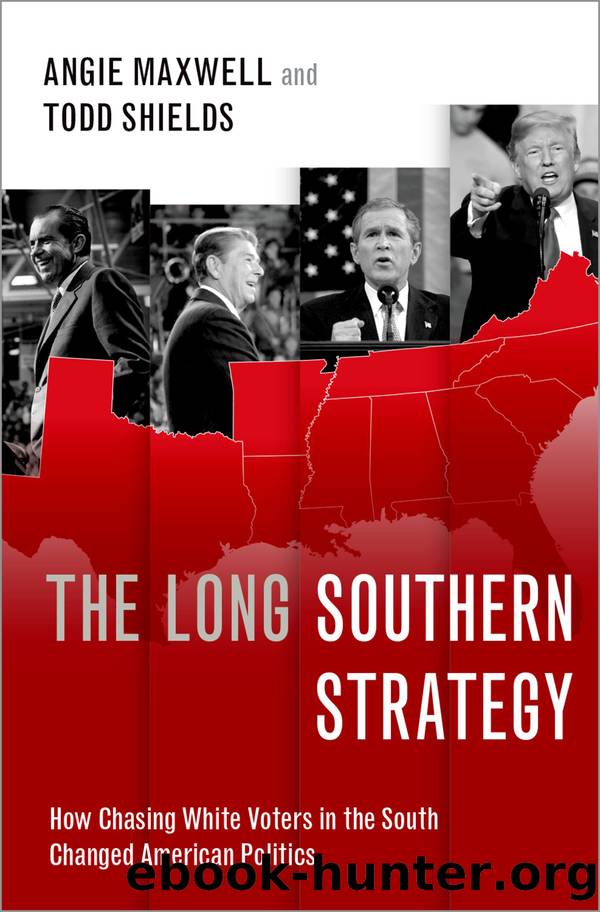
Author:Angie Maxwell & Todd Shields
Language: eng
Format: epub
Publisher: Oxford University Press
Published: 2019-11-15T00:00:00+00:00
the shift to a politically active religiosity did, of course, have its roots in past conflicts. The SBC had flexed its political muscles in the early twentieth century on major conflicts regarding Prohibition, evolution, and even integration.26 However, this was a new beast altogether. As political issues either threatened the institutional power of the church or challenged traditions that needed to be upheld, a southern religious bloc began to rally and organize. It would go on to build an infrastructure that included âparentsâ networks, legal defense funds, and lobbying groups.â27 One such early trigger issue arose from the Supreme Court decisions banning prayer in schools in Engel v. Vitale (1962) and school Bible devotionals in Abington v. Schempp (1963). At first, the SBC publicly backed the decisions, perhaps because they were hesitant to build a political alliance with Catholics who were fighting the prayer in school decisions vehemently. However, some Protestants feared that Catholics were gaining too much power in the wake of President John Kennedyâs election to the presidency.28 The SBC also recognized that the rulings were not being enforced and worried that bringing attention to them would warrant executive action,29 surely reminiscent of President Dwight Eisenhowerâs federal intervention in the Little Rock Central High School desegregation showdown a few years earlier.
However, in the end, when additional attempts to actually amend the Constitutionâthus forcing a Supreme Court reversalâfailed, the religious faithful promised action. The 1966 Dirksen Amendment, which prohibited the government from banning âany school, school system, educational institution or other public building supported in whole or in part through the expenditure of public funds from providing for or permitting the voluntary participation by students or others in prayer,â30 failed by close margins (nine votes shy of the two-thirds needed to pass the Senate). The failure prompted southern religious leaders such as Billy Graham to vow a public political fight from churchgoers. By the first Reagan administration, the SBC would pass a series of resolutions encouraging the Supreme Court to shift from a separationist perspective to the âaccomodationist doctrineâ in which studentsâ free exercise was paramount.31 Southern religiosity would be playing offense as opposed to defense.
The transformation of evangelical fundamentalists from politically inactive to a 66 percent self-reported turnout rate in 1984 remains one of the most radical shifts in modern American politics. Nearly three-fourths of those voters chose Ronald Reagan despite the fact that only half claimed a Republican affiliation.32 By 1988, turnout among biblical literalists hit 73 percentâup from 34 percent in 1964âas voting was encouraged from the pulpit.33 From 1980 to 2000, the percent of Southern Baptist ministers who claimed a GOP party identification increased from 27 to 85 percent,34 and research has shown predictably that the climate of the church has a strong political impact on its members.35 After all, the demographic characteristics of these âdoctrinally conservative Christiansâ were more representative of non-voters that active politicos. They were, in the years preceding the politicization of the SBC, âmore likely to have lower levels of education,
Download
This site does not store any files on its server. We only index and link to content provided by other sites. Please contact the content providers to delete copyright contents if any and email us, we'll remove relevant links or contents immediately.
| Anthropology | Archaeology |
| Philosophy | Politics & Government |
| Social Sciences | Sociology |
| Women's Studies |
The Secret History by Donna Tartt(19467)
The Social Justice Warrior Handbook by Lisa De Pasquale(12293)
Thirteen Reasons Why by Jay Asher(9118)
This Is How You Lose Her by Junot Diaz(7056)
Weapons of Math Destruction by Cathy O'Neil(6466)
Zero to One by Peter Thiel(5951)
Beartown by Fredrik Backman(5936)
The Myth of the Strong Leader by Archie Brown(5623)
The Fire Next Time by James Baldwin(5582)
How Democracies Die by Steven Levitsky & Daniel Ziblatt(5322)
Promise Me, Dad by Joe Biden(5229)
Stone's Rules by Roger Stone(5186)
A Higher Loyalty: Truth, Lies, and Leadership by James Comey(5087)
100 Deadly Skills by Clint Emerson(5023)
Rise and Kill First by Ronen Bergman(4890)
Secrecy World by Jake Bernstein(4877)
The David Icke Guide to the Global Conspiracy (and how to end it) by David Icke(4850)
The Doomsday Machine by Daniel Ellsberg(4619)
The Farm by Tom Rob Smith(4611)
